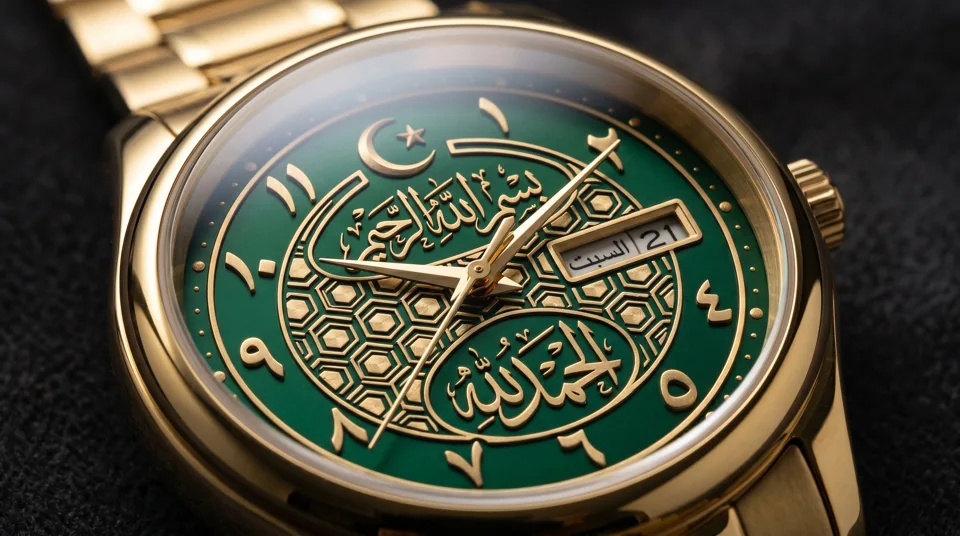
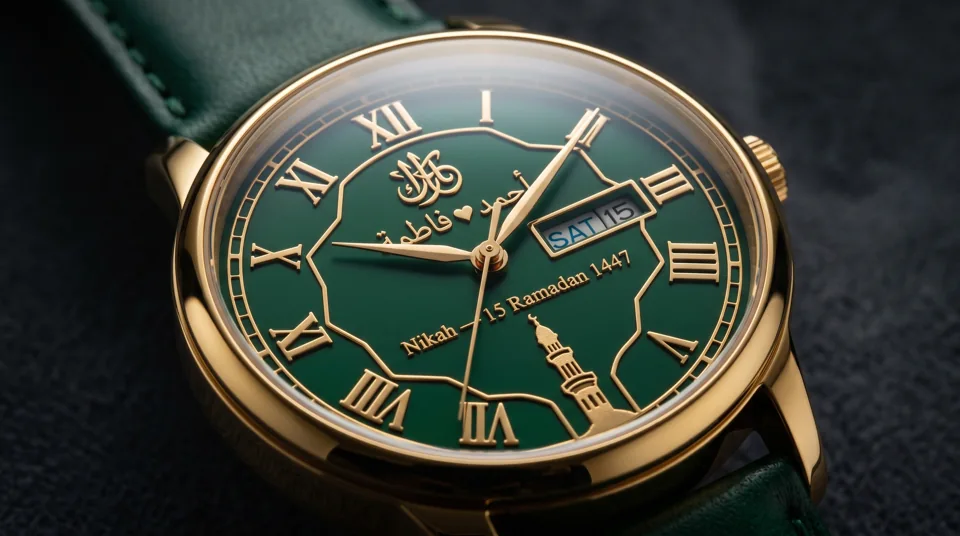
Geometric Islamic-art watch dial
A closer look
A star-like geometric pattern gives the green dial a repeating structure, with pale numerals around the edge. The lines are central to the design rather than a small decorative addition. Keeping their spacing clear is as important as deciding how many of them to include.
A pattern with personal meaning
The Arabesque draws its direction from geometric ornament and can be adapted around a motif you supply. It may suit someone who values the pattern itself, with little or no inscription. Describe the reference you care about rather than expecting a generic pattern to represent an entire tradition.
Find the lines worth keeping
A repeating pattern can be simplified to create space for the numerals and hands. Choose whether the pattern or a short inscription should be the focus.
Start with the rhythm of the geometric pattern rather than its maximum possible density. Repeated shapes can be opened up near the numerals or a short inscription. We can discuss which lines belong in the surface and which broader elements might suit raised detail.
Give repeated lines enough separation
The geometric design depends on repeated gaps as well as the lines themselves. Review a small section at the intended size: fine lines can be directly engraved, while only sufficiently broad shapes should be considered for raised detail.